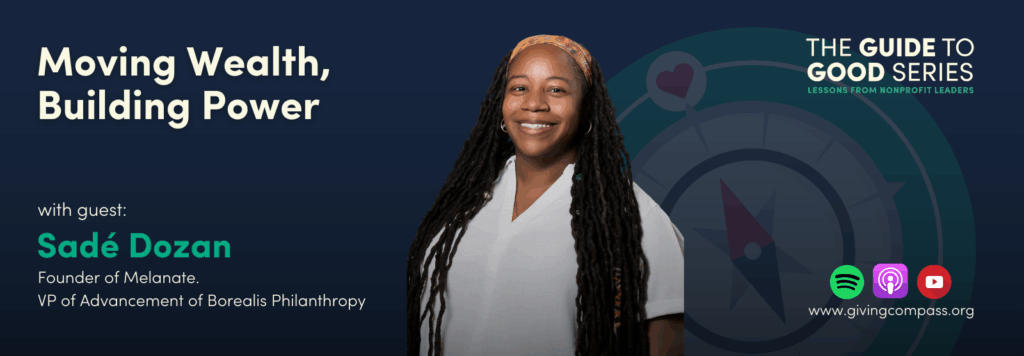
In a recent episode of The Guide to Good series, Brandolon Barnett, Head of Innovation and Philanthropy at Giving Compass, sat down Sade Dozan, Founder at Melanate. and Vice President of Advancement at Borealis Philanthropy to explore a powerful reframing: what if giving wasn’t just generosity, but a responsibility — an essential part of our civic infrastructure? Their conversation envisions what it would be like to move beyond transactional giving and toward a practice rooted in solidarity, shared accountability, and sustained trust in communities. Plus, Logan the cat makes a quick cameo!
Building an Ecosystem of Trust
Dozan founded Melanate. In part to re-engineer the infrastructure of trust and wealth movement, especially for Black women and gender-expansive people. “I wanted to ensure we weren’t just invited into the room,” she explains, “but that we’re also the architects designing how that room is built.” Through Melanate., Dozan train fundraisers to see resourcing not as charity, but as a collective ecosystem.
That ecosystem ties into Dozan’s other role at Borealis Philanthropy, a social justice intermediary that acts as a bridge between grassroots movements and institutional donors. Together, these entities are a reminder that resourcing is not linear but a living network of relationships that connects donors, nonprofits, and communities in pursuit of shared liberation.
The Role of Identity and Reflection
During the conversation, Dozan explained that her own identities and lived experiences as someone who is Black, Latina, queer, disabled, and a caregiver inform her belief that money is a tool for collective stability and freedom, not control. “I come to this work as someone who’s lived with the tension between survival and possibility,” she shared.
Knowing how her own background influences her perspective, Dozan encourages donors to think about how their identities are shaped. Philanthropy, she said, has long centered donor identity around comfort and goodness rather than accountability to communities. Instead of asking, “How can I do good?,” donors should be asking, “How can I be in right relationship?”
That reflection starts with an internal audit. Donors can ask:
- What does it look like to invest in a community, not just fund a project?
- What does sustained support mean in practice?
Understanding the answers requires deep, ongoing conversation with everyone in the ecosystem, including community leaders, nonprofits, and intermediaries who bridge wealth and grassroots wisdom.
Redefining Impact and Time Horizons
One of philanthropy’s biggest challenges is its obsession with quick results. “Change doesn’t work on a quarterly cycle,” said Dozan. True impact unfolds over generations. Instead of chasing metrics, donors should measure success in the health of relationships or whether communities are able to rest, rebuild, and dream.
This means moving beyond voyeuristic forms of visibility — proof points and polished stories — and embracing narratives that reflect the long, often messy work of transformation. “We can’t undo systemic issues through soundbite storytelling,” Dozan said. “[Donors] need to become saturated in the longer narrative.”
Practicing Solidarity, Not Charity
When giving becomes a practice rather than a transaction, it transforms both the donor and the community. In this way, legacy becomes about more than name recognition; it’s about sustained commitment. “Don’t give to be thanked,” said Dozan. “Give to be transformed.”
That might mean stretching into new spaces of learning and discomfort, supporting trans aliveness work as part of gender equity, or funding the invisible infrastructure of change, like professional development, operational costs, or storytelling efforts. These investments may not make headlines, but they make transformation possible.
As Dozan reminded listeners, “Philanthropy is a practice of values.” It’s about asking the hard question: “What would it look like if my giving wasn’t about generosity, but about solidarity?” Because solidarity means more than standing beside, it means holding the door open, sometimes with both hands, so others can walk through.
When people give from that place — of accountability, of interconnectedness, of shared power — philanthropy stops being an act of charity. It becomes the cornerstone of civic infrastructure, and a living practice of collective care.
Here are a few recommended articles related to best practices in giving:
- Supporting Black Leadership in Philanthropy
- Creating a Strategic Collective Vision to Organize for a Better Future
- The Grant Program Supporting Innovation and Systems Change in Philadelphia
- Improving Access to Long-Term Capacity Building for Nonprofits and Funders